How to Read the Santa Teresa Surf Report Like a Local
A practical field guide to reading the Santa Teresa surf report without getting fooled by star ratings. Learn how swell, wind, tide, and break choice change the call.
Key takeaways
- A Santa Teresa surf report is a live read on Playa Santa Teresa, an exposed beachbreak inside the Golfo de Nicoya on Costa Rica's Nicoya Peninsula — not a generic Costa Rica forecast and not interchangeable with Tamarindo or the southern zone.
- Because most forecast models predict open-water swell, not breaking waves.
- There is no single magic direction — and the sources that cover this coast disagree, which is itself the useful information.
What Are the Current Surf Conditions in Santa Teresa?
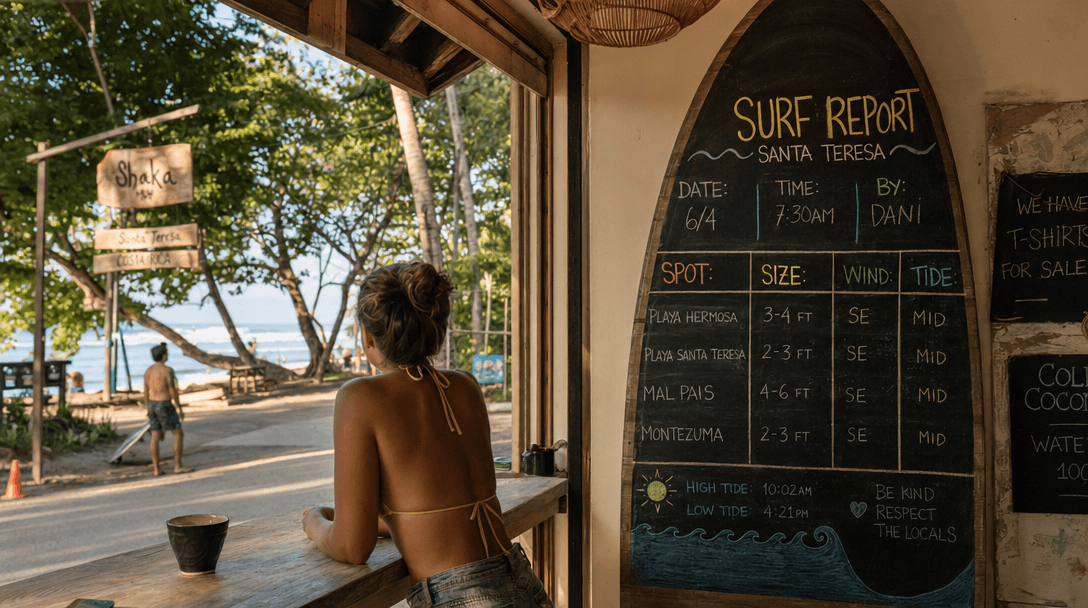
A Santa Teresa surf report is a live read on Playa Santa Teresa, an exposed beachbreak inside the Golfo de Nicoya on Costa Rica's Nicoya Peninsula — not a generic Costa Rica forecast and not interchangeable with Tamarindo or the southern zone. According to Surf-Forecast.com, this stretch of coast usually has waves and can work at any time of year, which is why the report matters more than the calendar.
What the report actually tells you is whether the open-water swell hitting Playa Santa Teresa, Playa Carmen, Playa Hermosa, La Lora, Suck Rock, or Mal Pais will translate into a paddle-able session at the specific break you have in mind. Surfline frames Playa Santa Teresa as a fun, hollow beachbreak with consistently good shape used by everyone from surf schoolers to traveling pros — which sounds friendly until you realize the same forecast number means different things at low tide on a long-period swell than it does at mid-tide on a soft windswell.
A Santa Teresa surf report is only useful once you read it as a beachbreak-specific signal, not a regional summary. The rest of this guide is how locals translate the numbers into a go/no-go call.
Read These Numbers Before You Trust the Rating
Stars and condition ratings hide more than they reveal. Scan the data in this order:
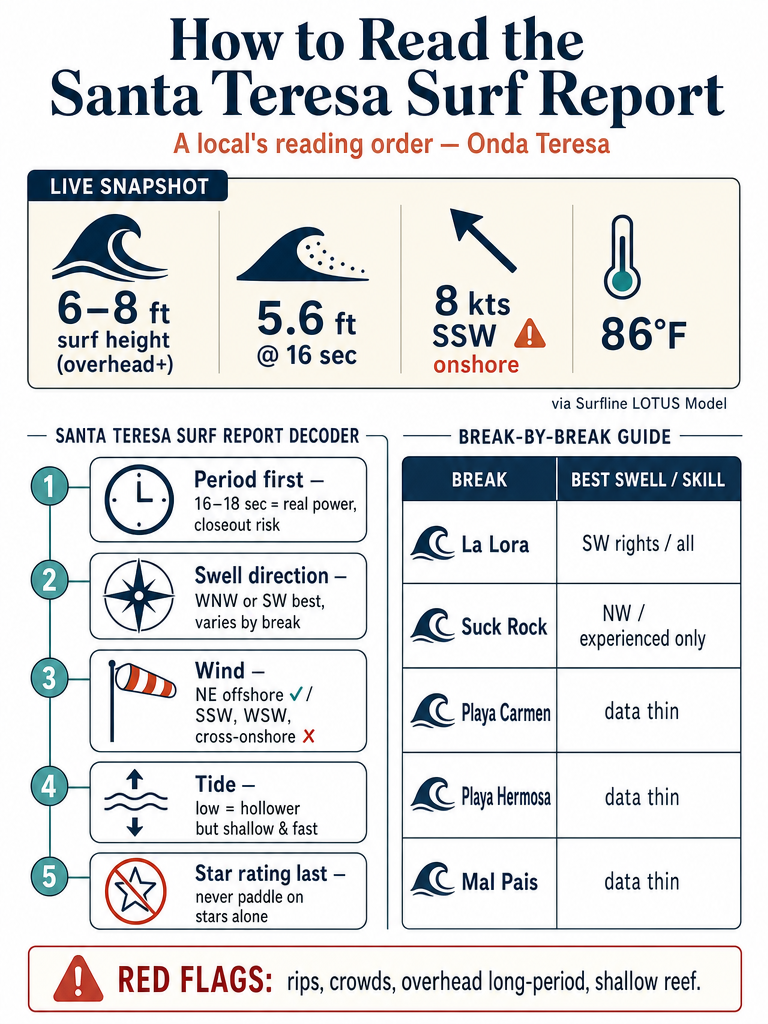
- Swell period — the most predictive number. A long-period Pacific groundswell (per Surfline's data feed, periods around 16 seconds are common at Santa Teresa) carries far more energy than a short-interval windswell of the same height.
- Swell direction — decides which break works (covered below).
- Surf height — the headline number, but the least useful in isolation.
- Wind speed and direction — northeast is offshore at Playa Santa Teresa per Surf-Forecast.com; anything else degrades shape.
- Tide stage and time — Playa Santa Teresa generally favors lower tides.
- Wave energy and consistency — Surfline's secondary metrics that tell you whether sets will actually show up.
A Surfline reading near 5–6 ft at a 16-second period with light onshore wind is a different beast than a 5-foot windswell. The size is similar; the experience is not.
Why Can the Forecasted Swell Differ From the Waves Breaking at Playa Santa Teresa?
Because most forecast models predict open-water swell, not breaking waves. Surf-Forecast.com states this directly: its Playa Santa Teresa forecast is for near-shore open water, and breaking waves will often be smaller at less exposed spots. That single disclaimer explains most of the gap between what your phone says and what you see when you walk down to the sand.
The Nicoya Peninsula coast is not uniformly exposed. Playa Santa Teresa catches almost everything the Pacific sends. Playa Carmen sits a notch more sheltered. Mal Pais and the coves around it filter swell further. The same Surf-Forecast.com number — for example, the 1.0 m at 16 seconds the model has flagged as a peak swell window in its 16-day outlook — will look chest-high on the open beach and noticeably smaller in a tucked corner.
Long-period swell is where this gets tactical. A primary swell around 0.7 m at 16 seconds — the kind Surf-Forecast.com identifies as the first 1-star-or-higher arrival in its forecast tables — has more underwater reach than its height suggests. Long-period waves jack up faster on the sandbar, paddle-outs get harder between sets, and closeout risk on a shallow low tide rises sharply. Visitors who only read surf height routinely get caught by this.
A "small" reading at 18 seconds will paddle, break, and punish like something noticeably bigger. Period beats height on the Nicoya coast.
What Swell Directions Work Best Around Santa Teresa Beach?
There is no single magic direction — and the sources that cover this coast disagree, which is itself the useful information. Surf-Forecast.com reports the ideal swell direction at Playa Santa Teresa as west-northwest, with the best reported conditions occurring when a WNW swell pairs with offshore northeast wind. Surfnerd, looking at the same break, calls southwest swells ideal. Both are right depending on which sandbar and which day you mean.
The neighboring breaks shift the answer further. Surfnerd says La Lora produces long, loping rights and shorter peaks on southwest swells, while Suck Rock fires shallow, fast tubes during northwest swells and is an experienced-surfer setup. Playa Carmen, Playa Hermosa, and Mal Pais get less published forecast coverage — most of what locals know about those breaks is communicated in the water, not in a model.
| Break | Swell direction that works | Skill level | Source |
|---|---|---|---|
| Playa Santa Teresa | WNW (best reported) and SW | Surf school to advanced | Surf-Forecast.com, Surfnerd |
| La Lora | SW | Intermediate+ | Surfnerd |
| Suck Rock | NW | Experienced only | Surfnerd |
| Playa Carmen | Underdocumented — check locally | Mixed | — |
| Playa Hermosa | Underdocumented — check locally | Mixed | — |
| Mal Pais | Underdocumented — check locally | Mixed | — |
Treat published direction guidance as a starting point, not a verdict, and always confirm with a beach check or a local report before committing.
What Wind Direction Is Offshore at Playa Santa Teresa?
Northeast. Surf-Forecast.com and Surfnerd agree: a northeast wind is offshore at Playa Santa Teresa and is the preferred direction for clean shape. Anything else should lower your confidence in the rating.
Here's how to read the wind line on a report without overthinking it:
- NE, light — green light. This is the combination that pairs with WNW swell for the best reported conditions on this coast (per Surf-Forecast.com).
- Light and variable, under 5 kts — usually fine; shape holds even if the direction isn't ideal.
- SSW — cross-onshore. Manageable when light, ugly as it builds. Surfline data feeds for Santa Teresa frequently show SSW wind in the single digits of knots, which is borderline workable.
- WSW — onshore-leaning. Per BreakFinder's hourly data, a session showing solid period (around 18 seconds) but WSW wind is the classic case where the swell is good but the wind is wrong; expect bumpy faces despite a strong period reading.
- Strong afternoon wind from any westerly quadrant — the dawn-patrol-or-skip-it signal.
Star ratings often get calculated before wind is fully weighted. A 4-star morning with light NE wind and a 4-star afternoon with onshore westerly wind are not the same session.
What Tides Are Best at Playa Santa Teresa?
Lower tides — but with a ceiling. Surf-Forecast.com says Playa Santa Teresa is best around low tide, and Surfnerd confirms the beachbreak gets hollower as the tide drops. Surfline echoes the "a bit hollower at low tide" framing. That's the consensus.
The nuance the sources skip: low tide is not a uniform window. The bottom of a big low on a long-period swell can turn the inside section into fast, shallow closeouts that punish anyone who isn't ready for them. Surf-Reports.com publishes a daily Playa Santa Teresa tide table — typically two highs and two lows over a 24-hour cycle, with low-tide heights that can dip well under a meter — and that data is the kind you actually need, but only if you pair it with swell period.
A practical reading rule:
- Pushing low to dead low, short-to-mid period — generally the best window for intermediates.
- Dead low, 16+ second period — fastest, hollowest, and most punishing; stronger surfers only.
- Mid tide, any period — softer takeoffs; better for beginners and surf-school sessions.
- High tide — often fat and sluggish on this coast; wait it out.
If you'd rather skip the cross-referencing, Onda Teresa publishes a Nicoya-specific surf and almanac dispatch that does this translation for you. Get the Nicoya dispatch for live conditions, vetted directory picks, and a peninsula briefing built by people who actually surf here.
Is Santa Teresa Good for Beginner Surfers?
Sometimes. The honest answer is that Santa Teresa is conditions-dependent, not categorically beginner-friendly. Surfline says the break is used by everyone from surf schoolers to traveling pros. Surfnerd categorizes it as "mostly suitable for intermediate surfers." BreakFinder rates it intermediate-level. All three are correct on different days.
A beginner-appropriate Santa Teresa session typically means: waist- to chest-high waves, mid tide, light or northeast wind, swell period under 13 seconds, and a sandbar peak with room away from the main crowd. An advanced-only session means overhead, long-period, dead-low tide, or a building afternoon wind. The same forecast page can describe both, an hour apart, depending on the tide.
| Skill level | Look for | Avoid |
|---|---|---|
| Beginner / surf school | 1–3 ft, 8–12 s period, mid tide, light wind | Long-period swell, dead low, overhead sets |
| Intermediate | 2–5 ft, 10–14 s period, low to mid tide, NE wind | Strong rips, crowded peaks, closeout days |
| Advanced | 4 ft+, 14–18 s period, low tide, clean NE wind | Onshore wind that ruins shape regardless of size |
Red Flags That Mean Visitors Should Not Paddle Out
If your report shows any of these, treat it as a no-go regardless of the star rating:
- Overhead surf height paired with a long period when you don't surf overhead at home.
- Strong rips — Surf-Forecast.com flags this explicitly for Playa Santa Teresa.
- Crowded peak with limited channels — also flagged by Surf-Forecast.com.
- Dead low tide on a long-period swell at an unfamiliar sandbar — fast, shallow, unforgiving.
- Suck Rock at any size if you are not an experienced tube rider — Surfnerd is explicit that this is shallow, fast, and for experienced surfers only.
- Cross-onshore or onshore wind that the rating hasn't fully priced in.
- Forecast that looks smaller on the model than the waves you see at the beach — trust your eyes.
Keep reading
When Should You Choose Playa Santa Teresa vs Playa Carmen, Playa Hermosa, La Lora, Suck Rock, or Mal Pais?
Use swell direction, period, wind, tide, and skill as a five-variable filter. The published research supports clear calls on three breaks; the rest require a local check, and saying so is more useful than guessing.
| Condition | Best break (per published research) | Notes |
|---|---|---|
| WNW swell + NE wind, low tide | Playa Santa Teresa | Surf-Forecast.com's stated best combo |
| SW swell, low to mid tide, NE wind | La Lora | Long, loping rights and shorter peaks (Surfnerd) |
| NW swell, low tide, experienced surfers only | Suck Rock | Shallow, fast tubes (Surfnerd) |
| SW swell, beginner / surf-school day | Playa Santa Teresa, mid tide | Softer peaks on the main beach |
| Onshore or strong westerly wind | Check Playa Carmen / Mal Pais corners | Underdocumented in published forecasts; ask locally |
| Big long-period day, intermediate | Playa Santa Teresa main peak | Open beach manages size better than reef |
| Big long-period day, advanced | Suck Rock if NW, otherwise main beach | Suck Rock only on the right direction |
For Playa Carmen, Playa Hermosa, and Mal Pais, the research corpus does not support direction- or tide-specific claims with the same confidence as Playa Santa Teresa, La Lora, and Suck Rock. The right move on those breaks is a beach check, a quick conversation with someone who surfed it that morning, or a locally maintained report — not a model extrapolation.
Which Santa Teresa Surf Report Tools Should I Use?
Use more than one, because no single tool covers all of swell, wind, tide, and local context well. Here is how the major sources compare for Playa Santa Teresa specifically.
| Tool | Strength | Weakness | Best used for |
|---|---|---|---|
| Surfline (LOTUS Model) | Clean current conditions, surf cam, condition rating, wave energy and consistency metrics | Star rating can mask wind quality | First-glance check and cam |
| Surf-Forecast.com | 16-day outlook, primary + secondary swell, wind at swell arrival, reliability comparison page | Open-water forecast — explicitly warns breaking waves may be smaller | Multi-day trip planning |
| Surfnerd | Clear break-by-break notes for Playa Santa Teresa, La Lora, Suck Rock | Less granular hourly data | Choosing which break to drive to |
| BreakFinder | Hourly wave height, period, wind, tides, custom alerts | Lighter on local context | Timing a session window |
| World Beach Guide | 10-day forecast with swell, wind, weather, sea temp | Generic presentation | Quick at-a-glance summary |
| Surf-Reports.com | Tide tables, first light, sunrise, sunset, last light alongside the forecast | Labeled under Guanacaste / Nandayure rather than Santa Teresa, which can confuse new users | Tide and daylight planning |
| Onda Teresa | Locally interpreted conditions updated every 30 minutes | Single-coast focus by design | Final pre-paddle check |
Unit and labeling differences matter. Surfline shows feet and knots. Surf-Forecast.com shows meters and seconds. Surf-Reports.com files Playa Santa Teresa under Guanacaste / Nandayure, which throws off visitors searching for "Santa Teresa." The fastest reliable workflow is one model source for swell, one local source for wind and beach reality, and a tide table you actually trust.
How Often Should You Re-Check the Santa Teresa Surf Forecast Before Paddling Out?
Three times, minimum, on the day you plan to surf. Models update, wind shifts, and a star rating posted at midnight is a poor guide to a 9 a.m. session.
A working pre-paddle workflow:
- The night before — check swell height, period, and direction on Surfline or Surf-Forecast.com. Decide which break the swell suits.
- First check on waking — confirm the wind forecast and the morning tide stage on Surf-Reports.com or BreakFinder. Cross-reference daylight: first light, sunrise, sunset, last light.
- 30 minutes before leaving — re-check current conditions on a frequently refreshed local source. Onda Teresa's surf report updates every 30 minutes, which is the resolution you want when wind is the swing variable.
- At the beach — eyes beat models. If the water disagrees with the forecast, the water wins.
Watch a full set cycle from the sand before you wax up. Three minutes of observation will tell you more about today's sandbar than any model.
When Is the Best Time to Surf Santa Teresa, and Should It Decide Your Base?
There is no single best month — and the published sources contradict each other for a reason. Surf-Forecast.com says Playa Santa Teresa works at any time of year. BreakFinder calls January, February, and March the most consistent window. Other regional guides point at the May–August wet season for size, and December–April for clean dry-season conditions. They are all describing real patterns; the right answer depends on what you optimize for.
| Window | What you get | What you trade |
|---|---|---|
| January – March | Consistent waves, clean dry-season wind, peak crowds | Highest prices, busiest lineups |
| December – April (broader dry season) | Reliable offshore mornings, easier roads | Variable swell within the window |
| May – August (early wet season) | Bigger, more frequent SW swell; emptier lineups | Rain, rougher roads, less daylight quality |
| September – November | Punchy swell, cheap stays | Heaviest rain, road and logistics friction |
Skill level filters the calendar further. Beginners want smaller, more forgiving days, which can show up in shoulder months. Intermediates want consistency, which favors the dry-season core. Advanced surfers chasing long-period south swell often score in the wet season when most visitors aren't there.
Whether surf access should anchor the trip is a separate question. Surfers who plan to paddle daily should base in Santa Teresa or Mal Pais; travelers who want a quieter, less wave-driven rhythm often prefer Montezuma. If you're weighing the call, our Santa Teresa or Montezuma comparison breaks down the tradeoffs by surf, dining, pace, and logistics.
For live, locally interpreted Santa Teresa surf intel, vetted directory picks across Santa Teresa, Montezuma, and Mal Pais, and a peninsula dispatch you can actually use to plan a session, subscribe to Onda Teresa — the report updates every 30 minutes, and the rest of the almanac stays honest because readers, not advertisers, pay for it.
FAQ
Does the surf report rating change between morning and afternoon in Santa Teresa?
Yes, often dramatically. Star ratings are frequently calculated before afternoon wind is fully weighted, so a 4-star morning with light northeast wind and a 4-star afternoon with onshore westerly wind describe completely different sessions. Re-check conditions at least 30 minutes before you leave, not just the night before.
How do I know if the swell shown in the forecast will actually produce waves at the beach I'm going to?
Most forecast models predict open-water swell, not breaking waves, and forecast providers say breaking waves are often smaller at less exposed spots. Do a beach check before you wax up and watch a full set cycle from the sand — three minutes of observation will tell you more about the day's sandbar than any model.
What's the difference between surfing Santa Teresa versus Mal Pais on the same swell?
Exposure is the key variable. Playa Santa Teresa catches nearly everything the Pacific sends, while Mal Pais and its coves filter swell further, often producing noticeably smaller surf from the same forecast number. When onshore or cross-onshore wind is hammering the main beach, tucked corners around Mal Pais can offer cleaner shape — but that intel comes from locals, not published models.
Is wet season actually worth it for surfing on the Nicoya Peninsula?
For surfers chasing size and empty lineups, yes. The May–August window brings bigger, more frequent southwest swell and noticeably thinner crowds, at the cost of rain, rougher roads, and less reliable morning conditions. Advanced surfers often rate it their preferred window precisely because most visitors aren't there.
Why does Surf-Reports.com file Santa Teresa under Guanacaste when I search for it?
Surf-Reports.com categorizes Playa Santa Teresa under Guanacaste / Nandayure rather than by the town name, which throws off first-time visitors searching for 'Santa Teresa.' It's still a useful tool for tide tables and daylight planning — just search by region rather than expecting the town name to surface it directly.
Santa Teresa eSIM and SIM Cards on Arrival
For most Santa Teresa trips, an eSIM is the cleanest answer: install it before you fly, keep your home number active, and arrive already connected. Buy a physical Costa Rican SIM only when you need a local number for calls, drivers, or a longer stay.
Read →Santa Teresa Pharmacies and Clinics: Where to Go
Public, verifiable pharmacy and clinic details for Santa Teresa are thin, and search results often mix in Wichita listings. This guide shows what to ignore and how to confirm care locally on the day.
Read →Santa Teresa Grocery Stores and Markets: What to Expect
Santa Teresa works best for daily top-ups, while Cóbano is the smarter larger shop. Mini markets cover water, eggs, bread, coffee, beer, and fruit.
Read →