Santa Teresa Rainy Season: What Still Works, What Doesn't
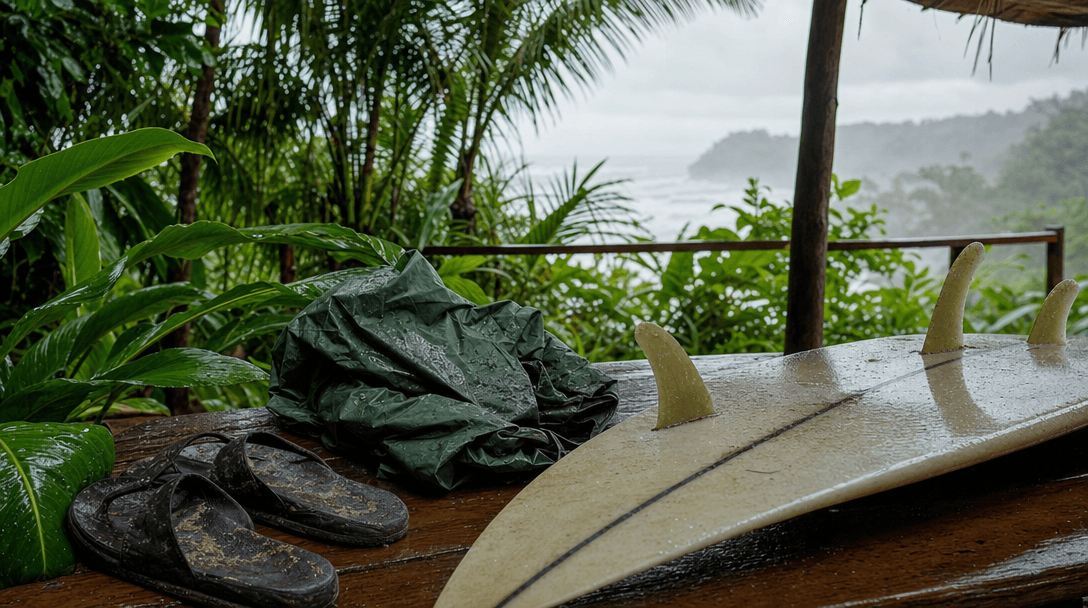
Santa Teresa rainy season is workable if you value morning surf, fewer crowds, and lower rates over guaranteed dry afternoons. The tradeoff is transport and timing, not a lost trip.
Key takeaways
- Santa Teresa works in rainy season if you'd trade guaranteed dry afternoons for cheaper rooms, emptier breaks, and greener hills.
- Santa Teresa's rainy season runs May through November, with the dry season filling December through April.
- No — green-season rain in Santa Teresa typically holds off until afternoon, then passes.
- Early green season (May through August) is the most manageable stretch; September through November is when rain intensifies and roads suffer most.
Is Santa Teresa worth visiting in rainy season?
Santa Teresa works in rainy season if you'd trade guaranteed dry afternoons for cheaper rooms, emptier breaks, and greener hills. The surf doesn't stop, the beach doesn't move, and the rain mostly arrives on a predictable afternoon schedule rather than ruining whole days. Hotel Tropico Latino says green-season hotel rates run 20–40% lower than peak season, while Puravida Traveling defines the wet window as May–November.
The honest tradeoff is logistics, not weather. The main downside in the sources isn't constant rain — it's rougher travel on unpaved roads when conditions turn muddy. Puravida Traveling highly recommends a 4×4 for rainy-season driving here, and notes Santa Teresa is a long, spread-out town where transport choices matter more once the roads get wet.
So the answer splits by traveler. If your day is built around morning surf, a slow lunch, and a dinner after the rain passes, green season is the better version of Santa Teresa — fewer crowds, sharper light, fuller waterfalls. If you need locked-in dry afternoons or you're nervous about driving rural roads in heavy rain, the December–April dry season is the safer bet.
Hotel Tropico Latino reports green-season rates in Santa Teresa running 20–40% below peak.
The rest of this guide separates the workable early-season rhythm from the heavier later months, then maps what actually still functions.
When is the rainy season in Santa Teresa?
Santa Teresa's rainy season runs May through November, with the dry season filling December through April. Puravida Traveling defines this split for the town directly, and other local sources echo the same May–November window. On the Nicoya Peninsula's Pacific side — Santa Teresa, Mal País, and nearby beaches — the pattern is more reliable than "rainy" suggests.
Costa Ricans call this stretch invierno (winter) or the green season. YokoVillage describes it running May until November and notes locals and many expats prefer it for the quiet and the scenery. Lapoint frames the wet months in three phases: May to June at the start, a July-to-August lull, then September through November when rains come down harder before tapering in December.
That phasing matters more than the broad dates. A first week of June and a last week of October are both technically "rainy season," but they don't feel the same on the ground. The useful split for planning is early green season (workable) versus late green season (heavier), not one undifferentiated wet block.
For getting here regardless of month, see getting to Santa Teresa by ferry, drive, or shuttle.
Does it rain all day in Santa Teresa during green season?
No — green-season rain in Santa Teresa typically holds off until afternoon, then passes. Hotel Tropico Latino describes the local rhythm plainly: mornings are usually clear, sunny, and warm; clouds build later, and rain arrives sometime between 2 PM and 6 PM, often heavy for an hour or two before clearing. Evenings are frequently dry again. YokoVillage agrees that it rains most days for minutes or hours, not all day, every day.
That rhythm is the whole reason green season functions. You get a built-in structure rather than a washout:
- Morning (clear): surf, beach, swim, hike, day trips, errands.
- Early afternoon (clouds build): lunch, a slower pace, indoor downtime.
- Mid-to-late afternoon (rain): the natural break — nap, read, work, wait it out.
- Evening (often clear): dinner, walking the strip, the beach at sunset.
The practical upshot is timing. Book the active part of your day before lunch, not after. Make dinner reservations on the later side so you're eating once the heavy stuff has passed. Treat any 4 PM plan as weather-dependent, and keep same-day flexibility — Santa Teresa's afternoon is the part that can flip.
Full-day rain happens, but it's the exception. YokoVillage notes it occasionally rains all day, just less often than the "rainy season" name implies.
If you're timing surf sessions around this, how to read the Santa Teresa surf report like a local covers the wind and tide side.
Which rainy-season months are manageable, and which get more disruptive?
Early green season (May through August) is the most manageable stretch; September through November is when rain intensifies and roads suffer most. Lapoint splits the season into three phases: May–June at the start, a July–August lull when rains wane, and September–November when "rains start coming down harder" before easing in December. That progression is the single most useful planning fact most travel pages skip.
Here's the phase-by-phase reality from the sources:
| Phase | Months | What to expect | Best for |
|---|---|---|---|
| Early green | May–June | Season begins; afternoon bursts that clear fast; hills turn green within days | First-timers wanting low crowds without peak disruption |
| Mid lull | July–August | Rains wane for a stretch; whale watching peaks Aug–Sep | Travelers who want the green-season quiet with a drier window |
| Heavy late | Sep–Nov | Rains come down harder; roads take the most damage | Experienced visitors comfortable with rougher logistics |
September through November is when unpaved roads degrade fastest. YokoVillage reports that heavy rains damage non-paved roads, trigger landslides, and make it harder to move around — its own crews regularly repair public roads to keep cars and trucks moving.
Two wildlife notes for timing the heavier months: Hotel Tropico Latino says olive ridley sea turtle activity in the region peaks roughly July to December, and YokoVillage flags August and September as prime whale-watching months. So the later, wetter stretch isn't a dead zone — it trades dry afternoons for stronger nature, lower prices, and emptier breaks. You're choosing what to optimize for.
What still works in Santa Teresa when it rains?
Most of a Santa Teresa trip stays intact in rainy season — you just front-load it. Mornings are typically clear enough for the beach, surf, and travel, per Hotel Tropico Latino, and the afternoon rain becomes a built-in rest window rather than a lost day. Waterfalls actually improve: YokoVillage notes they run stronger from the increased water volume.
What reliably still works:
- Morning beach and swim time. Clear, warm, sharp light before the clouds build.
- Surf. Conditions hold through the wet months — more on level fit below.
- Waterfalls. Fuller and more dramatic with the extra rainfall (Montezuma's are the obvious draw nearby).
- Low-crowd town days. Fewer people on the strip; tables and breaks open up.
- Dinners after the rain. Evenings often clear — book later and eat dry.
- Same-day flexibility. Cheaper, emptier conditions make pivoting easy.
The catch is that the sources don't name specific indoor venues, coworking spots, or wellness studios that stay reliably open in heavy rain — that's a local, on-the-ground question more than a published one. Plan the active stuff for the morning and keep the afternoon loose.
For trip length around this rhythm, see how many days in Santa Teresa is actually enough, and for where to eat, Santa Teresa restaurants worth it for a short trip.
Can you still surf in Santa Teresa during rainy season?
Yes — surf continues through Santa Teresa's rainy season, and several sources call conditions often excellent from May to November. Puravida Traveling describes the wet months as consistent for surf, and notes that May through November often brings bigger swells suited to more experienced surfers. The waves don't pause when the rain starts; they're frequently better.
The level question is where you need local validation rather than blanket claims. Bigger swell helps experienced surfers and can overpower beginners, but the published sources here don't give a clean break-by-break breakdown across Playa Carmen, La Lora, Playa Hermosa, and Mal País for rainy-season specifics. That's a live-conditions call, not a static one.
A few grounded principles:
- Bigger swell skews experienced. Puravida Traveling ties the wet season to larger waves better suited to confident surfers.
- Beginner fit depends on the break and the day, not just the season — which is why a static report isn't enough.
- Morning sessions beat afternoon ones in green season, since the clear window comes first.
For matching swell, wind, and tide to your level before you paddle out, use the best time to surf Santa Teresa by swell, wind, and tide. If you're weighing instruction, Santa Teresa surf lessons: when to book a school vs a coach breaks down the formats, and Santa Teresa vs Mal País for surf stays covers base choice.
Keep reading
- Best Time to Surf Santa Teresa by Swell, Wind, and Tide
- Santa Teresa vs Mal Pais for Surf Stays: What Changes
- Santa Teresa for Digital Nomads: What Gets Annoying Fast
- Santa Teresa Surf Lessons: When to Book a School vs a Coach
- Do You Need a Car in Santa Teresa? The Honest Tradeoffs
- Santa Teresa Airport Transfers: What Actually Works
Do I need a 4x4 in Santa Teresa during rainy season?
A 4×4 is the safer choice for rainy-season driving in Santa Teresa, and one source recommends it outright. Puravida Traveling highly recommends a 4×4 rental for the wet months and notes Santa Teresa is a long, spread-out town on unpaved roads — exactly the conditions that punish low-clearance cars once rain turns surfaces muddy. YokoVillage reinforces this, reporting that heavy rains damage non-paved roads and trigger landslides.
But you don't always need to drive at all. The honest version:
| Option | Rainy-season fit | Notes |
|---|---|---|
| 4×4 rental | Best for exploring, hills, Mal País and Montezuma runs | Recommended by Puravida Traveling for wet roads |
| Shared shuttle | Solid door-to-door without driving | ~5–6 hrs from SJO or LIR incl. ferry (Puravida Traveling) |
| Private transfer | Lowest friction for arrival | See the transfer guide below |
| Walking | Works if you stay central | Stay near Playa Carmen or central Santa Teresa |
| ATV / scooter | Common locally, riskier on muddy night roads | Sources don't cover wet-road safety specifics |
On routes: shared shuttles from San José or Liberia run about 5–6 hours including the ferry, while bus travel can exceed 8–9 hours (Puravida Traveling). Onda Teresa's getting-there guide puts SJO to Santa Teresa at 4–5 hours via the ferry route and Liberia overland at 3–3.5 hours, with the Puntarenas–Paquera crossing on Naviera Tambor taking about 75 minutes.
Match this to your lodging first. See do you need a car in Santa Teresa, how to get around Santa Teresa, and Santa Teresa airport transfers.
Want the conditions, road notes, and surf intel before you book? Get the Nicoya dispatch.
What should I pack for Santa Teresa in rainy season?
Pack for predictable afternoon rain, dark evenings, and wet roads — not for a monsoon. Lapoint's rainy-season list for the region is the practical baseline, and it's light: bring rain protection, wet-capable footwear, and a layer for cooler damp hours.
The grounded essentials, from Lapoint:
- Rain jacket or poncho — there's usually at least one full-rain day a week.
- Shoes that can get wet — water shoes, sandals, or sneakers you don't mind soaking.
- Umbrella — useful in the rain and, per Lapoint, hard to avoid otherwise.
- Flashlight or headlamp — for earlier darkness and unlit stretches.
- A sweater or fleece — Lapoint notes mornings and evenings can turn a bit chilly in the wet season, warmer than a raincoat alone covers.
That's it from the sources. The climate stays warm and humid year-round, so this is rain-and-mud prep layered onto a normal beach packing list, not cold-weather gear.
How much cheaper is Santa Teresa in green season?
Green-season hotel rates in Santa Teresa run 20–40% lower than peak season, per Hotel Tropico Latino. Flights into San José (SJO) and Liberia (LIR) are generally cheaper too, since demand drops once dry season ends. For travelers on a budget, that's a real discount on the same beach, the same surf, and the same restaurants — Hotel Tropico Latino's point is that the destination doesn't change, only the price and the crowd.
The savings cut two ways. If you normally book the cheapest room, green season stretches the trip — a longer stay or extras you'd skip in December. If you usually spend more, it buys a better room for the same budget.
What the discount does not erase is transport friction. The unpaved roads and ferry timing don't get cheaper or smoother because it's low season — if anything, wet roads add cost in the form of a 4×4 or a more careful route. Budget for that separately. The room is 20–40% off; the logistics aren't.
What is the best time to visit Santa Teresa for sunny weather?
For the most reliable sun in Santa Teresa, visit December through April — the dry season defined by Puravida Traveling. Those months bring the steadiest dry afternoons and the lowest rain odds, which is why they're also the busiest and priciest. December through March specifically draws a consistent influx from North America and Europe, per Hotel Tropico Latino, filling breaks and booking out rooms.
The tradeoff is straightforward:
| Dry season (Dec–Apr) | Green season (May–Nov) | |
|---|---|---|
| Sun | Most reliable, dry afternoons | Clear mornings, afternoon rain |
| Crowds | Busiest, breaks fill up | Fewer people, more space |
| Prices | Peak | 20–40% lower on hotels |
| Landscape | Hills turn brown, dusty | Green within days of rain |
| Surf | Consistent | Consistent, often bigger swell |
Dry season also has a hidden cost beyond money: Hotel Tropico Latino notes the dry months strip color from the hills and bring "harsh hot nights," while the rainy season delivers cooler, fresher evenings. So "sunny" and "best" aren't the same answer. If you want guaranteed dry afternoons and don't mind crowds and peak rates, go December–April. If you'll trade some afternoon rain for fewer people, lower prices, and greener surroundings, green season holds up.
For pacing and base decisions either way, see how many days in Santa Teresa is actually enough and where to stay in Santa Teresa by beach, road, and noise.
Onda Teresa tracks conditions, roads, and breaks on the ground year-round — get the Nicoya dispatch before you plan your trip.
Sources
- SANTA TERESA RAINY SEASON : r/CostaRicaTravel - Redditwww.facebook.com
- Hey guys!! Currently staying in Santa Teresa and it is raining.www.lapointcamps.com
- A DAY IN MY LIFE IN COSTA RICA DURING RAINY SEASON + ...hoteltropicolatino.com
- Santa Teresa in May: What to Expect | Fermatawww.puravidatraveling.com
- Santa Teresa, Costa Rica: Complete Travel Guidewww.reddit.com
FAQ
Does it rain all day in Santa Teresa during rainy season?
No — rain typically holds off until 2–6 PM, then passes within a couple of hours. Mornings are usually clear, warm, and sunny, leaving a clean window for surfing, swimming, and hiking. Evenings often clear again. Occasionally a full-rain day hits, but Hotel Tropico Latino describes that as the exception, not the rule — the afternoon pattern is predictable enough to plan around.
How much cheaper is Santa Teresa in green season?
Hotel rates run 20–40% lower than peak season, per Hotel Tropico Latino. Flights into San José (SJO) and Liberia (LIR) also drop as dry-season demand fades. The beach, the surf, and the restaurants don't change — only the price and the crowd size do. One honest caveat: the unpaved roads don't get cheaper, and a 4×4 rental may offset some of the room savings.
Which months of rainy season in Santa Teresa are manageable versus disruptive?
May through August is the most workable stretch. Lapoint breaks it into three phases: May–June at the start, a July–August lull when rains ease, then September–November when rain intensifies and road damage peaks. YokoVillage confirms heavy late-season rains trigger landslides and degrade unpaved roads. August and September also bring prime whale-watching, so the harder months trade logistics friction for better nature.
Can you still surf in Santa Teresa during rainy season?
Yes — Puravida Traveling describes May through November as consistent for surf, often with bigger swells better suited to experienced surfers. Morning sessions are the smart call since the clear window comes first. Beginners aren't necessarily shut out, but swell size and break character vary by spot and day, so a static seasonal verdict isn't enough — live conditions matter more than the calendar.
Do I need a 4x4 in Santa Teresa during rainy season?
Puravida Traveling recommends it outright for the wet months. Santa Teresa is long and spread-out on unpaved roads that turn muddy fast. YokoVillage reports heavy rain triggers landslides and road damage that require active repair. If you're staying centrally near Playa Carmen, walking is viable. Shared shuttles from San José run about 5–6 hours including the ferry and skip the driving problem entirely.
What should I pack for Santa Teresa in rainy season?
Pack for predictable afternoon rain, not a monsoon. Lapoint's practical list: a rain jacket or poncho, shoes that can get wet (sandals or sneakers you don't mind soaking), an umbrella, a flashlight or headlamp for earlier darkness, and a light sweater or fleece for cooler mornings and evenings. The climate stays warm and humid year-round — this is rain-and-mud prep layered onto a normal beach kit.
Santa Teresa eSIM and SIM Cards on Arrival
For most Santa Teresa trips, an eSIM is the cleanest answer: install it before you fly, keep your home number active, and arrive already connected. Buy a physical Costa Rican SIM only when you need a local number for calls, drivers, or a longer stay.
Read →Santa Teresa Pharmacies and Clinics: Where to Go
Public, verifiable pharmacy and clinic details for Santa Teresa are thin, and search results often mix in Wichita listings. This guide shows what to ignore and how to confirm care locally on the day.
Read →Santa Teresa Grocery Stores and Markets: What to Expect
Santa Teresa works best for daily top-ups, while Cóbano is the smarter larger shop. Mini markets cover water, eggs, bread, coffee, beer, and fruit.
Read →