Where to Stay in Santa Teresa for Walkability vs Quiet
Santa Teresa is walkable in pockets, not as one compact town. This guide shows when Playa Carmen, Playa Santa Teresa, North Santa Teresa, Mal Pais, or Playa Hermosa makes the most sense.
Key takeaways
- For the easiest daily walking in Santa Teresa, book along the main road through Playa Carmen and Playa Santa Teresa, where the beach, cafés, restaurants, and surf shops sit within a flat stroll.
- Santa Teresa is walkable in patches, not end to end.
- North Santa Teresa is the calmer, more sea-level base that stays close to daily life, while Central Santa Teresa puts you in the densest, loudest concentration of shops and surf.
- Quiet in Santa Teresa points to three bases: North Santa Teresa, elevated walkable stays, and the edges at Mal Pais and Playa Hermosa, though the deeper you go for silence, the more you give up walk-to-dinner ease.
Where to stay in Santa Teresa for walkability?
For the easiest daily walking in Santa Teresa, book along the main road through Playa Carmen and Playa Santa Teresa, where the beach, cafés, restaurants, and surf shops sit within a flat stroll. Two Weeks in Costa Rica says the majority of businesses in the area cluster in Playa Carmen and Playa Santa Teresa along the single main road.
Everything you want to walk to hangs off that one route. It runs from the fishing village of Mal Pais through Playa Carmen and Playa Santa Teresa up to Playa Hermosa in the north.
The tradeoffs break down cleanly:
- Main-road Santa Teresa gives the flattest, shortest walks to daily life, but you sleep closer to traffic and night noise.
- North Santa Teresa stays calmer and more sea-level, still close to surf, yoga, and cafés (Source: Casa Taralli).
- Elevated walkable stays deliver views and quiet, with short uphill walks as the price (Source: Feeling PURA VIDA).
- Mal Pais and Playa Hermosa are the wrong call if walking to everything is the priority; Playa Hermosa sits about 10-15 minutes north of the main strip by vehicle (Source: Two Weeks in Costa Rica).
If walk-to-dinner convenience is your top filter, stay on or just above the main road in Playa Carmen or Playa Santa Teresa, not on the edges.
Get the Nicoya dispatch: subscribe here.
Is Santa Teresa walkable?
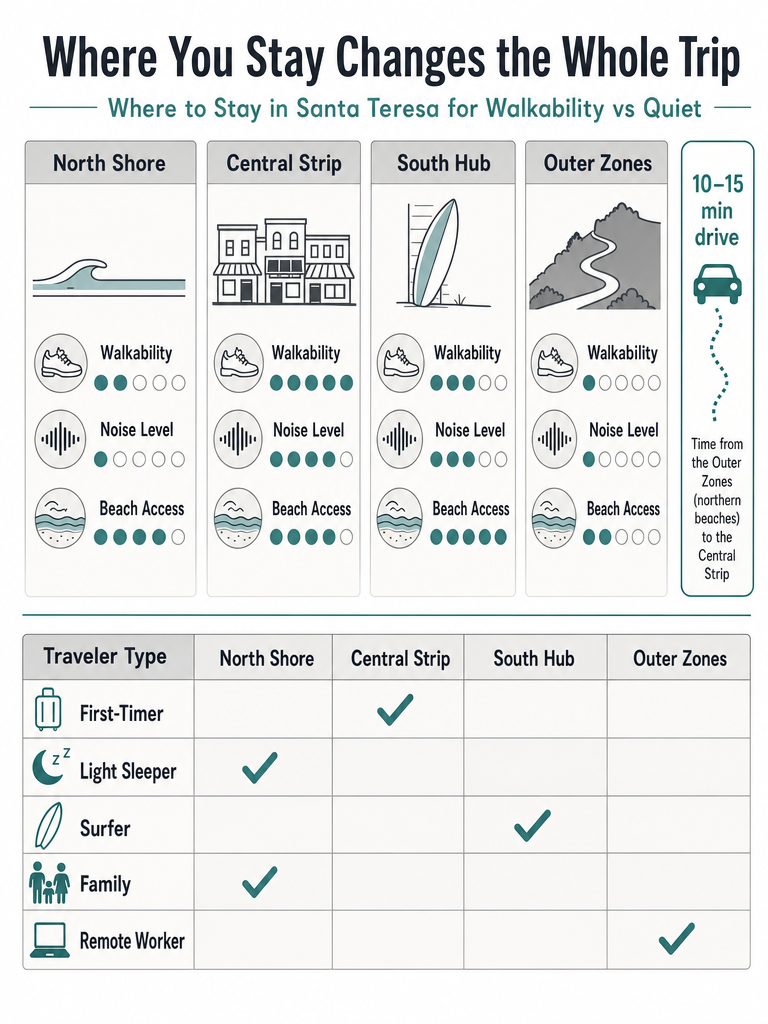
Santa Teresa is walkable in patches, not end to end. One main road links Mal Pais, Playa Carmen, Playa Santa Teresa, and Playa Hermosa, and most businesses concentrate in Playa Carmen and Playa Santa Teresa (Source: Two Weeks in Costa Rica). That concentration is what makes a well-placed stay feel walkable, and a badly placed one feel stranded.
Santa Teresa is a stretch of coastline with noticeably different pockets, not one compact town (Source: Casa Taralli). Where you stay changes the trip more than most first-time visitors expect.
Two things complicate the "just walk" picture. First, hills. Some central stays sit at the top of a steep grade between the road and the beach, so "near the beach" on a map can mean a climb in practice (Source: Casa Taralli). Second, movement patterns: many people get around on foot, motorcycle, and ATV, which tells you the strip is spread out enough that not everyone treats it as fully walkable (Source: Two Weeks in Costa Rica).
The honest version is that walkability here is a booking decision, not a town-wide feature. From the business-dense middle you can leave the car keys behind. From a hilltop or out toward Playa Hermosa, daily errands turn into rides.
For a fuller breakdown by road and noise, see how Santa Teresa splits by beach, road, and noise.
North Santa Teresa vs Central Santa Teresa: which is quieter without feeling cut off?
North Santa Teresa is the calmer, more sea-level base that stays close to daily life, while Central Santa Teresa puts you in the densest, loudest concentration of shops and surf. Casa Taralli describes the north end as quieter, newer in housing stock, and easier at sea level, while noting some central stays require a steep hill between road and beach.
Existing guides disagree about the north, and it's worth being precise. Casa Taralli reads it as quieter and residential, while Costa Rica Travel Life describes North Santa Teresa as the more upscale area with nightlife that gets loud on weekends. Rather than treat "North Santa Teresa" as one flat label, judge the specific stay by two things: how close it sits to the business cluster in Playa Santa Teresa, and whether there's a hill between you and the sand.
| Area | Feel | Beach access | Walk to cafés and dinner |
|---|---|---|---|
| North Santa Teresa | Calmer, more residential | Often sea-level, easier | Still close to surf, yoga, cafés (Casa Taralli) |
| Central Santa Teresa | Active, denser, louder in high season | Some stays involve a steep hill | Thickest concentration of shops and surf (Casa Taralli) |
North Santa Teresa is the sweet spot for travelers who want quiet mornings but still expect to walk to a café.
Central Santa Teresa can feel more crowded and less settled, especially in high season (Source: Casa Taralli). If your ideal trip is a private pool and slow mornings, the middle is usually the weaker fit.
What is the best area to stay in Santa Teresa for quiet?
Quiet in Santa Teresa points to three bases: North Santa Teresa, elevated walkable stays, and the edges at Mal Pais and Playa Hermosa, though the deeper you go for silence, the more you give up walk-to-dinner ease. Casa Taralli frames the north end as the calmest all-around choice for families, couples, and remote workers, while Two Weeks in Costa Rica points quieter travelers toward Mal Pais or Playa Hermosa.
Here's how the quiet options rank against convenience:
| Area | Quiet level | Walk-to-dinner tradeoff |
|---|---|---|
| North Santa Teresa | Calm, still connected | Minimal; close to cafés and surf (Casa Taralli) |
| Elevated walkable stays | Quieter feel, better views | Short uphill walks (Feeling PURA VIDA) |
| Mal Pais | Edge-of-town escape | Loses walk-to-everything ease (Casa Taralli) |
| Playa Hermosa | More remote | About 10-15 min north of the main strip (Two Weeks in Costa Rica) |
Feeling PURA VIDA describes the elevated walkable zone as a rare balance: a calmer atmosphere and open ocean or sunset views, with no car needed and only short uphill walks. That's the option that keeps quiet and convenience in the same booking.
Mal Pais is quiet in a different way. It's less about walk-to-everything and more about escape, and some travelers realize too late they wanted easier access to restaurants and beach walks (Source: Casa Taralli). If quiet is the goal but you still want to leave the car parked, start with North Santa Teresa or an elevated stay before considering what Mal Pais is actually like to stay in.
Should you stay in Playa Carmen if you want cafés, surf, shops, and nightlife nearby?
Playa Carmen is the most practical base if you want restaurants, shops, surf access, and night movement within reach, and you don't mind bustle. Two Weeks in Costa Rica calls Playa Carmen the main beach in town, usually with the most going on and abundant restaurants and shops up by the road.
Casa Taralli frames Playa Carmen and the southern stretches toward Mal Pais as fits for surfers, budget travelers, and people who care more about being near the action than about softness or privacy. The same source flags the flip side: it's less ideal for light sleepers and families with young children.
So the decision splits by who you are:
- Surfers get the beach and the town's busiest stretch at the door.
- Budget travelers find Playa Carmen more practical when chasing price over setting (Source: Casa Taralli).
- Nightlife-focused visitors stay closest to where the movement happens after dark.
- Light sleepers and families with young kids tend to regret it.
Playa Carmen buys you proximity to everything at the cost of quiet, so it's a great call for surfers and a poor one for anyone who needs silence by 10 p.m.
If your real filter is surf sessions rather than nightlife, weigh where to stay for surf access, not vibes before booking on noise alone. For the after-dinner window, Santa Teresa nightlife explains where the movement actually is.
Keep reading
- Where to Stay in Santa Teresa by Beach, Road, and Noise
- How to Get Around Santa Teresa Without Wasting Half a Day
- Where to Stay in Santa Teresa for Surf Access, Not Vibes
- Where to Stay in Mal Pais If You Hate Santa Teresa Chaos
- Santa Teresa vs Mal Pais for Surf Stays: What Changes
- Do You Need a Car in Santa Teresa? The Honest Tradeoffs
Do you need a car in Santa Teresa?
Whether you need a car in Santa Teresa depends almost entirely on where you sleep. Feeling PURA VIDA says sleeping along the main road keeps you within walking distance of the beach, cafés, restaurants, and daily activities, while hilltop and jungle stays usually require a car. Two Weeks in Costa Rica confirms many people get around on foot, motorcycle, and ATV.
A no-car trip is realistic from a main-road or true walkable stay in the Playa Carmen to Playa Santa Teresa cluster. An elevated walkable stay still works without a car, since the friction there is short uphill walks rather than distance (Source: Feeling PURA VIDA).
The picture flips at the edges:
| Stay type | Car likely needed? |
|---|---|
| Main road, walkable town | No; walk to daily life (Feeling PURA VIDA) |
| Elevated walkable views | No; short uphill walks (Feeling PURA VIDA) |
| Hilltop or jungle | Yes; car required (Feeling PURA VIDA) |
| Mal Pais | Usually; edge-of-town, spread out (Casa Taralli) |
| Playa Hermosa | Usually; 10-15 min north of the strip (Two Weeks in Costa Rica) |
Decide lodging location first, then decide on a car. The right main-road pocket can turn a rental from mandatory into optional.
ATVs and motorcycles are common precisely because the strip is spread out and some local roads stay rough dirt (Source: Two Weeks in Costa Rica). For the full breakdown, see do you need a car in Santa Teresa and how to get around without wasting half a day.
Where should I stay in Santa Teresa: North Santa Teresa, Playa Carmen, Mal Pais, or Playa Hermosa?
Your base comes down to how much noise you'll trade for convenience. North Santa Teresa suits calm-seekers who still want to walk to cafés, Playa Carmen suits surfers and night owls, and Mal Pais or Playa Hermosa suit travelers who accept driving for deeper quiet. Casa Taralli and Two Weeks in Costa Rica map these zones along the one main road.
| Traveler type | Best base | Why |
|---|---|---|
| First-timers who want to walk | Central / North Santa Teresa | Closest to the business cluster (Two Weeks in Costa Rica) |
| Families with young kids | North Santa Teresa | Sea-level access, calmer (Casa Taralli) |
| Couples, longer stays | Elevated walkable stays | Views, quiet, no car needed (Feeling PURA VIDA) |
| Remote workers | North Santa Teresa | Quieter, still close to cafés (Casa Taralli) |
| Surfers | Playa Carmen / south | Near the action and surf shops (Casa Taralli) |
| Budget travelers | Playa Carmen | More practical when chasing price (Casa Taralli) |
| Nightlife-focused | Playa Carmen | Most movement after dark (Two Weeks in Costa Rica) |
| Quiet over convenience | Mal Pais / Playa Hermosa | Edge-of-town escape (Casa Taralli) |
Pick the pocket by what you can't compromise on: quiet sleep points north, walkable action points to Playa Carmen, and deep calm points to the edges you'll have to drive to.
Light sleepers and families with small kids should steer clear of Playa Carmen and the southern stretches (Source: Casa Taralli). If you're still torn between towns entirely, compare Santa Teresa or Montezuma and Nosara or Santa Teresa.
How to choose a Santa Teresa stay without trusting hotel photos too much
Photos are the easiest way to book the wrong pocket, because the map matters more than the marketing. Casa Taralli warns that the town has steep hills in some pockets and meaningful differences between the north end and the central or southern strips, so a listing that looks beachfront can hide a climb.
Run every candidate through this checklist before you pay:
- Map position. Is it inside the Playa Carmen to Playa Santa Teresa business cluster, or out toward the edges (Source: Two Weeks in Costa Rica)?
- Hills. Does a steep grade sit between the road and the beach? Central stays often do (Source: Casa Taralli).
- Beach-access friction. North Santa Teresa's sea-level access is the real differentiator; if kids or older relatives are along, favor it (Source: Casa Taralli).
- Main-road noise. The busiest strip runs through Playa Carmen and Playa Santa Teresa, so those stays trade quiet for convenience (Source: Two Weeks in Costa Rica).
- Light-sleeper risk. Playa Carmen and the southern stretches are flagged as less ideal for light sleepers (Source: Casa Taralli).
- Truly walkable vs merely nearby. Elevated walkable stays are within walking distance but add short uphill walks; hilltop and jungle stays require a car (Source: Feeling PURA VIDA).
"Steps from the beach" in a photo can mean a hillside descent, not a flat stroll. Check the topography, not the caption.
Public detail on hotel-by-hotel noise, dust exposure, and stroller or mobility access is limited as of this writing, so verify those directly with the property before you commit.
What to check next: surf access, car need, noise, and rainy-season movement
Once you've picked a walkable-vs-quiet base, the next decisions are surf access, whether to rent a car, noise by road position, and how rainy-season roads change daily movement. Two Weeks in Costa Rica notes some local roads around Santa Teresa are still rough dirt, which matters more in the wet months.
Work through these before you lock the trip:
- Surf access: match your base to sessions, not photos, with where to stay for surf access and beginner breaks by conditions.
- Car tradeoffs: confirm whether your pocket needs wheels using the honest car tradeoffs.
- Noise by road: cross-check your candidate against beach, road, and noise.
- Packing for dust and rain: the strip is a surf town, not a cloud forest, so pack accordingly with what to pack for Santa Teresa.
- Rainy-season logistics: see what still works in rainy season and getting to Santa Teresa.
Get the Nicoya dispatch: subscribe here.
Sources
- What's the best area to stay in Santa Teresa, Costa Rica?www.facebook.com
- Santa teresa - which part of town should I stay incasataralli.com
- Where to Stay in Santa Teresa, Costa Rica - Casa Taralliwww.twoweeksincostarica.com
- THE 10 BEST Quiet Hotels in Santa Teresawww.youtube.com
- Santa Teresa: Costa Rica's Trending Beach Townfeelingpuravida.com
- Where to stay in Santa Teresa - Best beaches and areascostaricatravellife.com
- Where to Stay in Santa Teresa - 11 BEST Hotels in Santa Teresa & Nearbywww.tripadvisor.com
FAQ
Where should I stay in Santa Teresa for walkability?
Stay on or just above the main road through Playa Carmen and Playa Santa Teresa — that's where cafés, surf shops, restaurants, and beach access cluster along one route. Most businesses in Santa Teresa concentrate in those two areas, so a well-placed booking there makes a car optional. Stray toward Mal Pais or Playa Hermosa and daily errands become rides, not walks.
Is Santa Teresa actually walkable, or do you need a vehicle?
Walkability depends entirely on where you book, not on the town as a whole. The main road spans roughly 8 km from Playa Carmen to Playa Hermosa, and many locals get around by foot, motorcycle, and ATV — which signals the strip is spread out. Stay in the Playa Carmen to Playa Santa Teresa cluster and a car is optional. Book a hilltop or jungle property and a vehicle is required.
North Santa Teresa vs Central Santa Teresa: which is quieter without feeling cut off?
North Santa Teresa is the calmer base that keeps you close to daily life. The housing stock skews newer, beach access is mostly sea-level, and you're still within reach of surf, yoga, and cafés. Central Santa Teresa puts you in the densest stretch of shops and surf but gets louder and more crowded in high season, and some central stays have a steep hill between the road and the sand.
What's the best area in Santa Teresa for quiet?
North Santa Teresa is the calmest all-around base for families, couples, and remote workers — quieter and sea-level, still close to cafés and surf. Elevated walkable stays just above the main road add ocean views and a calmer feel with only short uphill walks and no car required. Mal Pais and Playa Hermosa go deeper into silence but trade away walk-to-dinner ease.
Should I stay in Playa Carmen if I want restaurants, surf, and nightlife nearby?
Playa Carmen is the right call if proximity to action matters more than quiet. It's the main beach with the thickest concentration of restaurants, shops, and after-dark movement. The tradeoff is direct: it's flagged as less ideal for light sleepers and families with young kids, and it's the loudest part of the strip, especially in high season.
Do you need a car in Santa Teresa?
Not if you pick the right pocket. Sleeping on the main road in the Playa Carmen to Playa Santa Teresa cluster puts the beach, cafés, and restaurants within walking distance. Slightly elevated walkable stays add short uphill walks but still need no car. Hilltop and jungle properties require one, and Playa Hermosa sits about 10–15 minutes north of the main strip by vehicle.
Santa Teresa eSIM and SIM Cards on Arrival
For most Santa Teresa trips, an eSIM is the cleanest answer: install it before you fly, keep your home number active, and arrive already connected. Buy a physical Costa Rican SIM only when you need a local number for calls, drivers, or a longer stay.
Read →Santa Teresa Pharmacies and Clinics: Where to Go
Public, verifiable pharmacy and clinic details for Santa Teresa are thin, and search results often mix in Wichita listings. This guide shows what to ignore and how to confirm care locally on the day.
Read →Santa Teresa Grocery Stores and Markets: What to Expect
Santa Teresa works best for daily top-ups, while Cóbano is the smarter larger shop. Mini markets cover water, eggs, bread, coffee, beer, and fruit.
Read →